previous
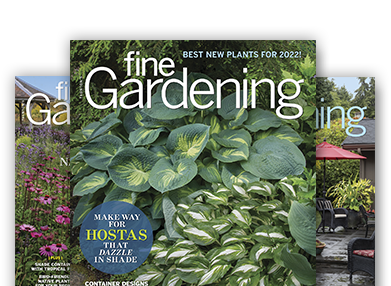
  • Meet Our Mini-Magazines
    Meet Our Mini-Magazines
  • NEW Video Series: There's a Better Way
    NEW Video Series: There's a Better Way
  • Dwarf Citrus Trees
    Dwarf Citrus Trees
  • Comfortable Alfresco Dining
    Comfortable Alfresco Dining
  • Designing with Curved Terraces
    Designing with Curved Terraces
  • In Pursuit of the Perfect Potting Shed
    In Pursuit of the Perfect Potting Shed
  • Stylish Shady Containers
    Stylish Shady Containers
  • Mulch for a Healthy Garden
    Mulch for a Healthy Garden
  • Colorful Selections for Shade
    Colorful Selections for Shade
  • Fragrant Plants for Pathways
    Fragrant Plants for Pathways
  • Building a Compost Bin
    Building a Compost Bin
  • Save Money by Growing Your Own
    Save Money by Growing Your Own
  • Pretty in Pink
    Pretty in Pink
  • Indeterminate or Determinate Tomatoes?
    Indeterminate or Determinate Tomatoes?
  • Fine Gardening's Tip Off!
    Fine Gardening's Tip Off!
  • Fast-Growing Trees for Impatient Gardeners
    Fast-Growing Trees for Impatient Gardeners
  • Garden Confidential: A Plant Walks into a Bar
    Garden Confidential: A Plant Walks into a Bar
  • 6 Tips for Weed Control
    6 Tips for Weed Control
  • Elephant's Ears
    Elephant's Ears
  • Containers as Focal Points
    Containers as Focal Points
  • Make a Succulent Topiary
    Make a Succulent Topiary
  • Slideshow: Beautiful Clematis
    Slideshow: Beautiful Clematis
  • Homegrown / Homemade
    Homegrown / Homemade
  • Plant an Easy-to-Water Strawberry Jar
    Plant an Easy-to-Water Strawberry Jar
  • Thoughts From a Foreign Field
    Thoughts From a Foreign Field
next

Browse Plants

Narrowed By:Zone: 4+ Flower Color: Orange/Salmon, Purple/Lavender
Displaying 1 - 20 of 175 listings   1 | 2 | 3 | 4 | 5 | 6 | 7 | 8 | 9View AllNext > Sort By: Sort
Achillea millefolium 'Terracotta' Achillea millefolium 'Terracotta'
(Yarrow)
(1 user review)
Hardiness Zones: 1 2 3 4 5 6 7 8 9 10 11

Flat-topped corymbs of small, daisy-like flowers in colors of salmon-peach to yellow-orange are borne simultaneously on one plant up to 2 feet tall and wide. Flowers are complemented by silvery-green, finely-textured foliage.

Agastache foeniculum Agastache foeniculum
(Anise hyssop)
(2 user reviews)
Hardiness Zones: 1 2 3 4 5 6 7 8 9 10 11

A classic plant for both herb gardens and borders, anise hyssop is composed of erect branches of mint-and-licorice-scented, medium green leaves ending in fuzzy spikes of small lavender flowers. The plant grows to 3 to 5 feet tall and 1 foot wide and reseeds freely. The flowers are edible and are charming crumbled into salads. The flowers are highly attractive to bees, butterflies, and hummingbirds.

Allium 'Globemaster' Allium 'Globemaster'
(Ornamental onion)
(2 user reviews)
Hardiness Zones: 1 2 3 4 5 6 7 8 9 10 11

Allium 'Globemaster' is a true showstopper, growing to about 32 inches tall. Very large, majestic purple spheres up to 8 inches across bear numerous star-shaped, deep lilac flowers in May and June.

Allium senescens Allium senescens
(Ornamental onion)
Be the first to rate this plant
Hardiness Zones: 1 2 3 4 5 6 7 8 9 10 11

This plant has thin, strap-like foliage that tends to twist. It produces up to 30 long-lasting, 12- to 40-inch-tall pink or lilac flowers in mid- to late summer.

Allium sphaerocephalon Allium sphaerocephalon
(Drumstick allium, Round-headed garlic)
(1 user review)
Hardiness Zones: 1 2 3 4 5 6 7 8 9 10 11

The drumstick allium has egg-shaped flowers in summer that start off green, then bloom and develop to pink and then clover red-purple. These plants are attractive in a bed or border, especially peeking up through other plants, such as roses, so that their nondescript foliage is hidden. Their vertical presence and eye-catching flower shape are valuable additions to the garden, and they naturalize freely.

Allium thunbergii Allium thunbergii
(Japanese onion)
Be the first to rate this plant
Hardiness Zones: 1 2 3 4 5 6 7 8 9 10 11

This is the last of the ornamental onions to flower, when mop-like heads of rose-purple flowers appear with orange anthers. The flowers are impervious to frost or snow. Superior cultivars include ‘Ozawa’, with larger purple flower heads than the species. A white-flowered form known as A. thunbergii ‘Alba’ is a splendid plant, with cup-shaped florets sporting white stamens, yellow anthers, and green centers.

Ampelaster carolinianus Ampelaster carolinianus
(Climbing Carolina aster)
Be the first to rate this plant
Hardiness Zones: 1 2 3 4 5 6 7 8 9 10 11

This perennial vine sends out abundant pale purple to lavender flowers beginning in late October. It grows to 4 to 5 feet tall, and frost does not seem to impede the blooms. It can attract bees and butterflies well into November.

To get the best flower display, give climbing aster as much sun as possible. It should also have something to lean on, like a fence, a trellis, or an ornamental shrub. Don't prune it over the winter, no matter how dead it may look. It’s better to wait to tidy up things after the new growth appears in spring.

Andropogon gerardii 'Pawnee' Andropogon gerardii 'Pawnee'
(Big bluestem, turkeyfoot)
Be the first to rate this plant
Hardiness Zones: 1 2 3 4 5 6 7 8 9 10 11

'Pawnee' has an upright habit and warm fall colors that persist into winter. This refined offbig bluestem has the bluish purple stems typical of the genus. In late summer, Purplish red flowers appear in groups of three or six, which look like a turkey foot—hence the nickname: "Turkey Foot Grass." The root system that can extend down more than 10 feet. Each year, a third of these roots die, opening up channels for water. -Scott Vogt, Native grasses, Fine Gardening issue #124

Angelica gigas Angelica gigas
(Angelica)
(1 user review)
Hardiness Zones: 1 2 3 4 5 6 7 8 9 10 11

This showstopper produces conspicuous, red-purple leaf sheaths with dense, purple domed flowerheads.

Arisaema sikokianum Arisaema sikokianum
(Japanese cobra lily)
(1 user review)
Hardiness Zones: 1 2 3 4 5 6 7 8 9 10 11

The outside of the spathe is the color of dark chocolate, and the inside, milk white and as smooth as marble. Its hood sweeps up to an arrogant point, exposing its sumptuous white lining and the thick blunt spadix, which is also milk white. This plant produces two leaves per tuber, one leaf with three lobes and one with five. Sometimes they are mottled with silver, which makes them very handsome, at least until the plant goes dormant in summer.

Arisaema triphyllum Arisaema triphyllum
(Jack-in-the-pulpit)
Be the first to rate this plant
Hardiness Zones: 1 2 3 4 5 6 7 8 9 10 11

A favorite of children, Jack-in-the-pulpit is a tuberous perennial producing one or two leaves, each divided into three narrow leaflets. But it's best known for its spring to early summer display of hooded, green spathes—Jack's pulpit—which are often striped with purple. Autumn brings clusters of densely packed, showy red berries.

Asarum canadense Asarum canadense
(Wild ginger, Canadian wild ginger)
Be the first to rate this plant
Hardiness Zones: 1 2 3 4 5 6 7 8 9 10 11

The rounded, lustrous leaves of this native plant form an appealing green ground cover. This plant produces beautiful, 2- to 4-inch, glossy green heart-shaped leaves. In spring, you'll find interesting, mauve-purple flowers hidden under its foliage. -Marty Hair, Regional Picks: Upper Midwest, Fine Gardening issue #127

Asarum europaeum Asarum europaeum
(European wild ginger)
(2 user reviews)
Hardiness Zones: 1 2 3 4 5 6 7 8 9 10 11

European wild ginger is a low-growing groundcover with glossy, evergreen, heart-shaped leaves. Its unusual purple-brown flowers lie mostly concealed beneath foliage.

Asclepias tuberosa Asclepias tuberosa
(Butterfly weed)
(5 user reviews)
Hardiness Zones: 1 2 3 4 5 6 7 8 9 10 11

Butterfly weed is a native perennial with flat-topped, orange or yellow flower clusters at the ends of its stems or in its leaf axils. From midsummer to autumn, it produces clusters of brightly colored flowers that attract insects, followed by fruit and showy seed. Plant in a border, meadow, butterfly garden, or wildflower garden.

Aster dumosus Aster dumosus
(New York aster, Michaelmas daisy)
Be the first to rate this plant
Hardiness Zones: 1 2 3 4 5 6 7 8 9 10 11

This is a short-growing aster with lilac-blue flowers and creeping rootstocks. Many cultivars exist. It can be used on steep slopes for erosion control.

Aster macrophyllus Aster macrophyllus
(Bigleaf aster)
Be the first to rate this plant
Hardiness Zones: 1 2 3 4 5 6 7 8 9 10 11

This striking, richly-textured, deciduous ground cover has heart-shaped leaves that turn mauve in autumn. Purple, blue, or white flowers appear in late summer to early fall.

Aster novae-angliae Aster novae-angliae
(New England aster)
Be the first to rate this plant
Hardiness Zones: 1 2 3 4 5 6 7 8 9 10 11

Strong, almost woody, stems bear large sprays (to 10 inches) of violet-purple flowers.

Aster novae-angliae ‘Purple Dome' Aster novae-angliae ‘Purple Dome'
(New England aster)
(9 user reviews)
Hardiness Zones: 1 2 3 4 5 6 7 8 9 10 11

Growing to less than 2 feet tall and wide, 'Purple Dome' covers itself with semi-double, deep purple, daisy-like flowers from late summer to midfall. In addition to being mildew resistant, it attracts butterflies. It's great as a border specimin and as a cut flower.

Aster tataricus Aster tataricus
(Tatarian aster)
Be the first to rate this plant
Hardiness Zones: 1 2 3 4 5 6 7 8 9 10 11

Tatarian aster is an impressive, stately perennial with a flowering height of 3 to 6 feet. It can look you in the eye yet require no staking. More important, this aster flowers longer than any other garden aster, beginning in late September and early October and continuing into November. The 1-inch-wide, light lavender flowers are a magnet for local and migrating monarch butterflies. This plant tolerates many soil types, can form large colonies in a few years, and is easily divided.

Baptisia × variicolor Twilite Prairieblues™ Baptisia × variicolor Twilite Prairieblues™
Be the first to rate this plant
Hardiness Zones: 1 2 3 4 5 6 7 8 9 10 11

This amazing baptisia is a cross between B. australis, the most common blue variety, and B. sphaerocarpa, a plant with yellow bloomer. The result is pea-like violet-purple flowers with dramatic yellow keels. It is long-lived, tough, and drought resistant, but it may take three or four gardening seasons to establish itself. Twilite Prairieblues™ blooms in late spring or early summer, When not in bloom, the plant remains attractive because of the lovely blue-green color of its trifoliate leaves, especially in spring. This plant is tall and will look good at the back of a border. -Stephanie Cohen, Plants to know and grow, Fine Gardening issue #120


Displaying 1 - 20 of 175 listings   1 | 2 | 3 | 4 | 5 | 6 | 7 | 8 | 9View AllNext > Sort By: Sort